

Only 3% of authors make more than $5,000 per year from their books alone—yet thousands of writers are building six-figure businesses around their published works. The question isn’t whether can writing a book make you money, but rather how savvy authors transform their manuscripts into multiple income streams that extend far beyond traditional book sales.
Most aspiring writers focus solely on royalties and advances, missing the bigger picture of how books actually generate wealth. The most successful authors understand that their book is not the product—it’s the marketing tool that opens doors to higher-paying opportunities.
This comprehensive guide reveals the real ways authors get paid in 2026, from direct sales to lucrative indirect income streams that can dwarf traditional publishing earnings.
Key Takeaways
• Direct book sales typically generate modest income ($0-$10,000 annually for most authors), but serve as the foundation for larger opportunities
• Indirect income streams like coaching, speaking, and courses often produce 5-10x more revenue than book sales alone
• Non-fiction books in specific niches consistently outperform fiction for generating business income
• Self-publishing offers faster market entry and higher royalty rates compared to traditional publishing
• Long-term strategy focusing on authority-building creates sustainable income growth over time
Can Writing a Book Really Make You Money?
Yes, writing a book can absolutely make you money—but the income varies dramatically based on your approach, niche selection, and marketing strategy. The key lies in understanding that successful authors rarely rely on book sales alone.
The Reality of Book Income
Most books sell fewer than 1,000 copies in their lifetime, generating minimal direct revenue. However, this statistic misses the broader financial picture. Authors who treat their book as a business asset rather than just a product consistently outperform those focused solely on sales numbers.
Key factors that determine your earning potential:
• Niche specificity – Solving clear problems for defined audiences
• Marketing commitment – Active promotion versus passive hoping
• Publishing method – Self-publishing speed versus traditional prestige
• Long-term vision – Building authority for future opportunities
Setting Realistic Expectations
The harsh truth: most first-time authors won’t quit their day jobs from book royalties alone. But here’s the encouraging reality—authors who develop strong writing habits and strategic thinking often build substantial businesses around their expertise.
Typical income progression:
- Year 1: $100-$2,000 (learning phase)
- Year 2-3: $2,000-$15,000 (building momentum)
- Year 4+: $15,000-$100,000+ (established authority)
How Authors Actually Make Money from Books
Understanding the various revenue streams available to authors is crucial for maximizing your earning potential. Let’s break down both direct and indirect income sources.
Direct Book Sales Revenue
Self-Publishing Royalties
Self-published authors typically earn 35-70% royalties depending on the platform and pricing strategy. Amazon Kindle Direct Publishing offers:
- 35% royalty for books priced under $2.99 or over $9.99
- 70% royalty for books priced between $2.99-$9.99
Volume vs. Pricing Strategy:
- High volume, low price: $2.99 book selling 1,000 copies = $2,093 profit
- Premium pricing: $19.99 book selling 200 copies = $2,799 profit
Traditional Publishing Income
Traditional publishers typically offer:
- Advances: $1,000-$50,000+ (paid upfront)
- Royalties: 8-15% of cover price after advance is earned back
- Timeline: 18-24 months from acceptance to publication
Pros and cons of traditional publishing:
✅ Professional editing and marketing support
✅ Bookstore distribution
❌ Lower royalty percentages
❌ Loss of creative control
The Audiobook Opportunity
Audiobooks represent the fastest-growing segment of the publishing industry, with revenues increasing 25% annually. Platforms like Audible offer:
- 10-25% royalty rates for exclusive distribution
- Higher price points ($15-$30 vs. $3-$15 for ebooks)
- Growing market demand among busy professionals
Many authors report audiobook sales comprising 30-50% of their total book revenue by 2026.
Indirect Ways Books Make You Money (Often More Profitable)
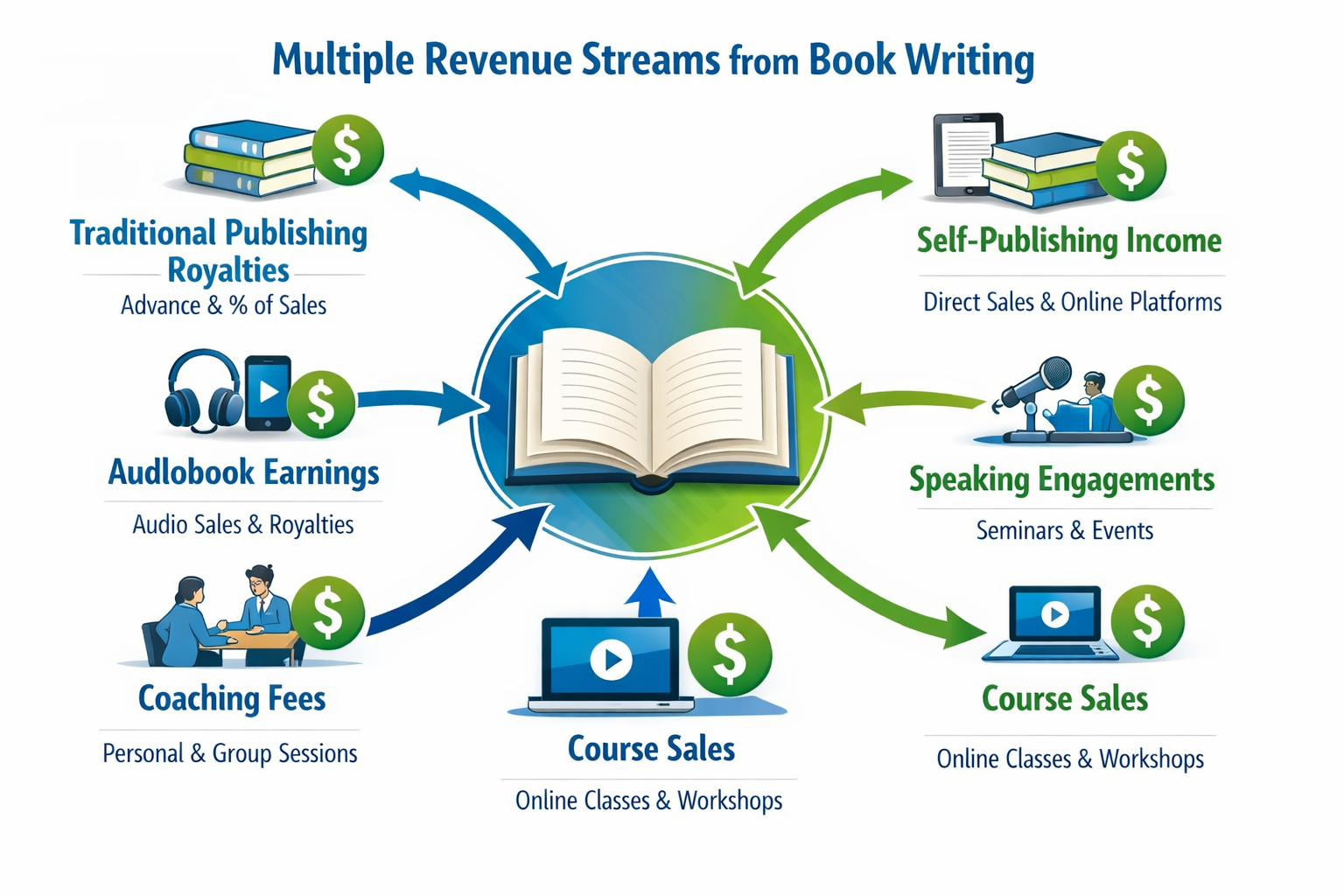
The most financially successful authors understand that books are authority-building tools that unlock higher-value opportunities. These indirect income streams often generate 5-10 times more revenue than book sales alone.
Building Expert Authority
Publishing a book instantly positions you as an authority in your field. This credibility opens doors to:
Higher-paying client work: Consultants report 40-60% rate increases after publishing
Media opportunities: Podcast interviews, speaking invitations, and press coverage
Partnership offers: Joint ventures and collaboration proposals
Digital Product Sales
Your book content can be repurposed into multiple digital products:
Online courses: Transform chapters into video lessons ($297-$2,997 price range)
Workshops: Live or recorded training sessions ($97-$497 per participant)
Templates and tools: Practical resources mentioned in your book ($27-$197)
For example, a book about social media marketing could spawn courses on Facebook marketing strategies or Instagram monetization.
Coaching and Consulting Services
Books serve as powerful client attraction tools. Readers who connect with your content become warm prospects for:
One-on-one coaching: $150-$500+ per hour
Group coaching programs: $497-$2,997 per participant
Corporate consulting: $2,000-$10,000+ per project
Speaking Engagements
Published authors command higher speaking fees:
- Local events: $500-$2,500
- Corporate workshops: $2,500-$10,000
- Conference keynotes: $5,000-$25,000+
Affiliate Marketing Integration
Strategically recommending tools and resources within your book can generate ongoing passive income through affiliate commissions (typically 5-50% of sale price).
How Much Money Can You Make Writing a Book?
Income potential varies significantly based on your strategy, niche, and execution. Here are realistic ranges based on 2026 market data:
Beginner Authors ($0-$2,000 annually)
- Focus: Learning the publishing process
- Common challenges: Limited marketing, broad topics, unrealistic expectations
- Typical outcome: 50-500 book sales
Strategic Authors ($2,000-$15,000 annually)
- Focus: Specific niche, consistent marketing
- Key activities: Building email lists, social media presence
- Typical outcome: 1,000-5,000 book sales plus some indirect income
Authority-Building Authors ($15,000-$100,000+ annually)
- Focus: Multiple income streams, established expertise
- Revenue sources: Books + courses + coaching + speaking
- Typical outcome: Sustainable business built around book content
Success Story Examples
Case Study 1: Self-help author
- Book sales: $8,000 annually
- Online course: $45,000 annually
- Coaching: $72,000 annually
- Total: $125,000
Case Study 2: Business consultant
- Book sales: $3,500 annually
- Speaking fees: $35,000 annually
- Consulting contracts: $180,000 annually
- Total: $218,500
Best Types of Books That Make Money
Not all book topics are created equal when it comes to earning potential. Certain genres and niches consistently outperform others in generating both direct sales and indirect opportunities.
High-Earning Non-Fiction Categories
Business and entrepreneurship
- How-to guides for specific industries
- Leadership and management strategies
- Marketing and sales techniques
Personal development
- Productivity and time management
- Health and fitness solutions
- Financial planning and investing
Professional skills
- Copywriting and marketing
- Technology and software tutorials
- Career advancement strategies
Profitable Fiction Approaches
While non-fiction dominates business income generation, fiction authors can succeed through:
Series development: Building loyal readerships across multiple books
Genre specialization: Becoming known for specific types of stories
Multimedia expansion: Adapting stories for other media
Niche-Specific Advantages
Books addressing specific problems for defined audiences consistently outperform broad-appeal titles. For example:
- “Email Marketing for Real Estate Agents” vs. “Digital Marketing Guide”
- “Meal Prep for Busy Nurses” vs. “Healthy Eating Cookbook”
Step-by-Step: How to Write a Book That Makes Money
Creating a profitable book requires strategic planning from concept to launch. Follow this proven framework to maximize your earning potential.
Step 1: Choose a Profitable Topic
Research market demand:
- Analyze bestseller lists in your category
- Study competitor books and reviews
- Survey your target audience about pain points
Validate your idea:
- Can you solve a specific problem?
- Is there a clearly defined audience?
- Are people already spending money on solutions?
Step 2: Write with Reader Value in Mind
Focus on delivering actionable insights rather than showcasing your expertise. Readers buy solutions, not impressive credentials.
Key writing principles:
- Lead with benefits, not features
- Include practical examples and case studies
- Write clearly and concisely
- Structure content for easy consumption
Step 3: Choose Your Publishing Strategy
Self-publishing advantages:
- Faster time to market (2-3 months vs. 18-24 months)
- Higher royalty rates (35-70% vs. 8-15%)
- Complete creative control
- Direct customer relationships
Learn more about self-publishing strategies to determine if this path aligns with your goals.
Step 4: Develop a Marketing Plan
Pre-launch activities (3-6 months before publication):
- Build email list of interested readers
- Create social media presence in your niche
- Develop relationships with influencers and peers
- Plan launch sequence and promotional calendar
Launch phase (first 30 days):
- Coordinate with your network for initial reviews
- Reach out to podcasts and media outlets
- Run targeted advertising campaigns
- Engage actively on social media
Post-launch (ongoing):
- Continue content marketing
- Speak at relevant events
- Build partnerships with complementary businesses
- Develop additional products and services
Step 5: Create Additional Income Streams
Immediate opportunities:
- Offer bonus materials for email subscribers
- Create companion workbooks or guides
- Develop email courses based on book content
Medium-term expansion:
- Launch online courses or membership sites
- Offer coaching or consulting services
- Secure speaking engagements
- Write additional books in the same niche
Long-term business building:
- Develop certification programs
- Create licensing opportunities
- Build affiliate partnerships
- Explore corporate training contracts
Common Mistakes That Kill Book Profits
Avoiding these critical errors can mean the difference between a profitable book and a costly learning experience.
Writing Without a Clear Audience
The mistake: Trying to appeal to everyone
The fix: Define your ideal reader specifically
- Demographics (age, profession, income level)
- Psychographics (values, challenges, goals)
- Behavioral patterns (where they spend time, what they read)
Ignoring Marketing Completely
The mistake: “If I write it, they will come”
The fix: Treat marketing as equally important as writing
- Allocate 50% of your time to promotion
- Start building audience before you finish writing
- Develop multiple marketing channels
Pricing Incorrectly
The mistake: Racing to the bottom with $0.99 pricing
The fix: Price based on value, not fear
- Research competitor pricing
- Test different price points
- Consider your positioning strategy
Expecting Instant Success
The mistake: Giving up after 3-6 months
The fix: Plan for long-term business building
- Set realistic timeline expectations
- Focus on building systems, not just selling books
- Measure progress beyond just sales numbers
Tips to Maximize Your Book Income
Implement these proven strategies to significantly increase your earning potential from book publishing.
Build Your Audience First
Start building relationships with potential readers months before publication:
- Email marketing: Grow a list of interested subscribers
- Content creation: Share valuable insights on social media and blogs
- Networking: Connect with others in your niche
- Speaking: Present at relevant events and conferences
Focus on Series Development
Single books have limited earning potential compared to series:
- Fiction series: Keep readers engaged across multiple books
- Non-fiction series: Cover different aspects of the same topic
- Seasonal updates: Refresh content annually with new editions
Leverage Your Book as a Business Card
Use your published work to:
- Attract higher-paying clients for your services
- Secure speaking opportunities at industry events
- Build partnerships with complementary businesses
- Establish media credibility for interviews and features
Create Evergreen Content
Focus on timeless topics that remain relevant:
- Fundamental principles rather than trendy tactics
- Universal human challenges like productivity, relationships, health
- Core business skills that don’t change with technology
Optimize for Multiple Formats
Maximize revenue by offering your content in various formats:
- Ebook: Low cost, high margin
- Paperback: Physical presence, gift potential
- Audiobook: Premium pricing, growing market
- Course: Interactive learning, highest value
Conclusion
Can writing a book make you money? Absolutely—but success requires treating your book as a business asset rather than just a creative project. The authors earning substantial income in 2026 understand that books are powerful tools for building authority, attracting opportunities, and creating multiple revenue streams.
The most important insight: your book’s financial success depends more on your strategic approach than your writing talent alone. Focus on solving specific problems for defined audiences, commit to consistent marketing, and view your book as the foundation for a broader business.
Your next steps:
- Choose a profitable niche where you can provide genuine value
- Start building your audience before you finish writing
- Plan multiple income streams beyond just book sales
- Commit to long-term business building rather than quick wins
Remember, the question isn’t whether books can generate income—it’s whether you’re willing to approach publishing with the strategic mindset of a successful entrepreneur. Start developing your writing skills today, and begin building the authority that transforms authors into profitable business owners.
The opportunity is real. The market is waiting. Your profitable book journey starts with your next decision to take action.


