

Picture this: You’re deep into writing your research paper when you realize you’ve referenced dozens of books but haven’t kept track of the citation details. Sound familiar? 📚 Learning how to write a book citation properly is one of the most crucial skills for academic success, yet it’s often overlooked until the last minute. Whether you’re a student working on your first research paper or an aspiring author who needs to understand proper attribution, mastering book citations will save you time, prevent plagiarism, and enhance your credibility as a researcher.
Key Takeaways
- Book citations require specific elements: author name, title, publisher, publication year, and sometimes page numbers
- Different citation styles (APA, MLA, Chicago) have unique formatting requirements for the same book
- Digital sources like ebooks need additional information such as URLs or DOIs
- Citation tools and software can automate formatting but understanding the basics remains essential
- Proper citations prevent plagiarism and give credit to original authors while strengthening your work’s credibility
What Is a Book Citation?
A book citation is a formal reference that provides readers with all the information needed to locate and verify a source you’ve used in your academic work. Think of it as a roadmap that leads others directly to the exact book and page where you found specific information.
In academic writing, book citations serve multiple purposes. They demonstrate that you’ve conducted thorough research, allow readers to verify your claims, and give proper credit to the original authors whose ideas you’ve incorporated into your work.
Book citations are required in virtually every type of academic writing, from high school essays to doctoral dissertations. You’ll need them when writing research papers, literature reviews, case studies, and even creative projects that reference existing works. For those interested in starting their own writing journey, understanding citations becomes even more important as you’ll need to properly attribute any sources you reference in your own published work.
Essential Elements of a Book Citation
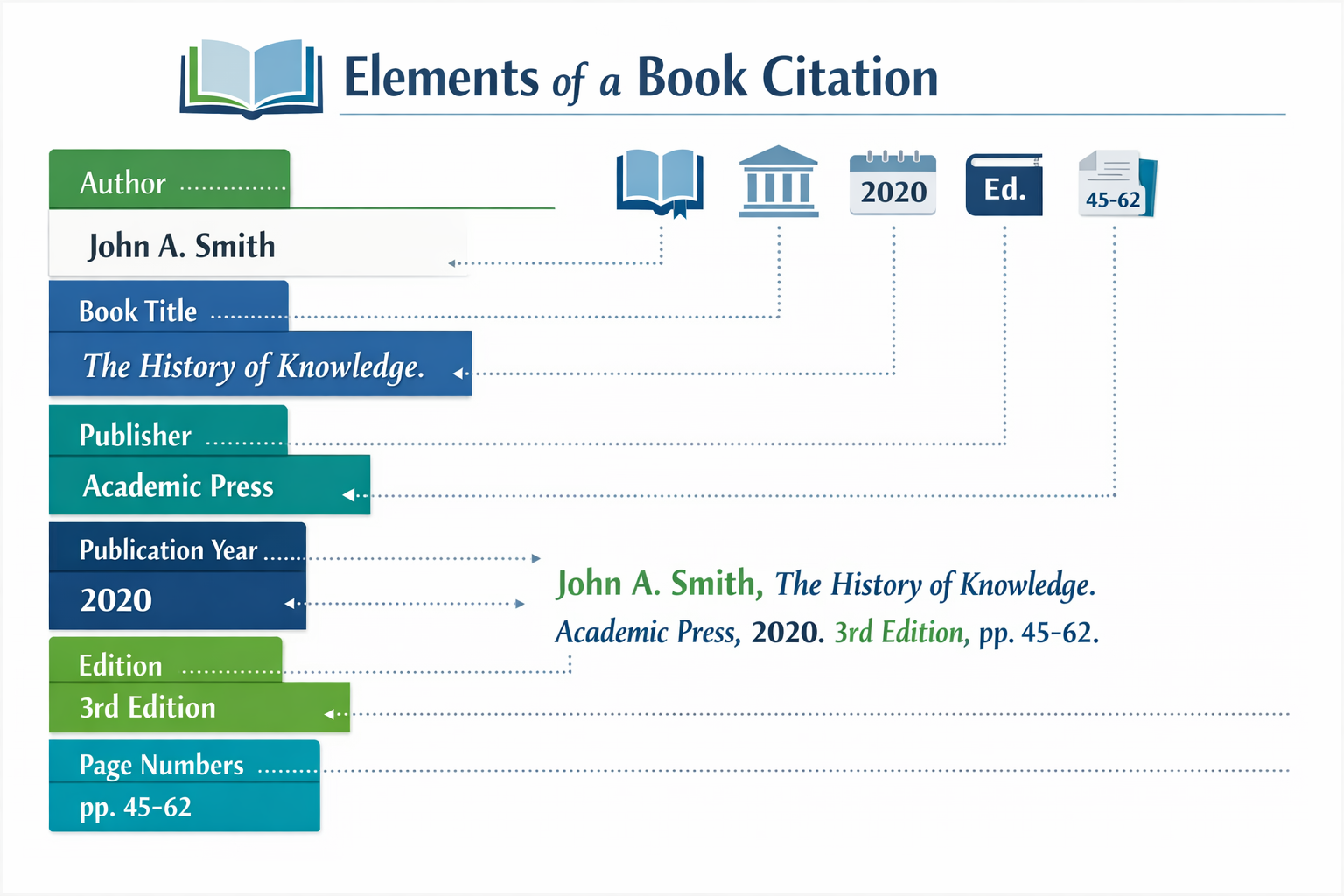
Understanding how to write a book citation starts with knowing what information you need to collect. Every complete book citation contains several key elements, though the order and formatting may vary depending on the citation style you’re using.
Author’s Name forms the foundation of any citation. For single authors, list the last name first, followed by the first name. When dealing with multiple authors, different citation styles have specific rules for how many names to include and when to use “et al.”
Book Title should always be italicized in most citation styles. Include the complete title and subtitle exactly as they appear on the book’s title page, not the cover. Pay attention to capitalization rules, which vary between citation styles.
Publisher Information includes both the publisher’s name and the location of publication. However, many modern citation styles have simplified this requirement, often requiring only the publisher’s name.
Publication Year tells readers when the book was published, which helps establish the currency and relevance of your source. Always use the most recent copyright date listed in the book.
Edition Information becomes crucial when citing books that have been revised or updated. If you’re using the second edition or later, this must be included in your citation.
Page Numbers are essential when you’re referencing specific information rather than the entire book. Include specific page numbers for direct quotes, statistics, or particular concepts.
How to Write a Book Citation in APA Style
The American Psychological Association (APA) style is widely used in psychology, education, and social sciences. Learning how to write a book citation in APA format follows a specific pattern that emphasizes the publication date.
The basic APA format for a book citation follows this structure:
Author, A. A. (Year). Title of book. Publisher.
Here’s a complete example:
Smith, J. D. (2023). Understanding research methods: A comprehensive guide. Academic Press.
For books with multiple authors, APA has specific rules. With two authors, connect them with an ampersand (&). For three or more authors, list all authors in the reference list, separating them with commas and using an ampersand before the final author’s name.
When citing a specific chapter from an edited book, the format changes slightly:
Chapter Author, A. A. (Year). Chapter title. In B. B. Editor (Ed.), Book title (pp. xx-xx). Publisher.
APA style requires specific capitalization for book titles – only capitalize the first word, the first word after a colon, and proper nouns. The rest of the title should be lowercase, even though this might look unusual.
How to Write a Book Citation in MLA Style
Modern Language Association (MLA) style is the standard for literature, language, and humanities courses. The MLA approach to how to write a book citation emphasizes the author’s name and uses a different structure than APA.
The basic MLA format follows this pattern:
Author Last Name, First Name. Title of Book. Publisher, Publication Year.
Here’s an example:
Johnson, Maria. Digital Age Communication. University Press, 2023.
MLA style capitalizes all major words in titles, unlike APA’s sentence case. This means you’ll capitalize nouns, verbs, adjectives, adverbs, and pronouns, but not articles, prepositions, or coordinating conjunctions (unless they’re the first word).
When citing specific pages in MLA, you typically don’t include page numbers in the Works Cited entry. Instead, you use in-text citations with the author’s last name and page number: (Johnson 45).
For books with multiple authors, MLA lists the first author with last name first, then subsequent authors with first name first: Smith, John, and Mary Jones.
How to Write a Book Citation in Chicago Style
Chicago style, also known as Turabian style, is common in history, literature, and the arts. This style offers two systems: notes-bibliography and author-date. Understanding how to write a book citation in Chicago style requires knowing which system your instructor prefers.
For the notes-bibliography system, the basic format is:
Author Last Name, First Name. Title of Book. Place of Publication: Publisher, Year.
Example:
Williams, Sarah. Modern Art Movements. New York: Art Publications, 2023.
The author-date system resembles APA format:
Author Last Name, First Name. Year. Title of Book. Place of Publication: Publisher.
Chicago style differs significantly in its use of footnotes or endnotes for in-text citations, rather than parenthetical citations. The first time you cite a source in a footnote, you include complete publication information. Subsequent citations can be shortened.
For those planning to write non-fiction books, understanding Chicago style becomes particularly important as it’s often preferred in academic and historical writing.
How to Cite an Ebook
Digital books require special consideration when learning how to write a book citation. Ebooks often lack traditional page numbers and may be accessed through various platforms, making citation more complex.
For APA style ebooks, include the DOI (Digital Object Identifier) when available:
Author, A. A. (Year). Title of book [E-book]. Publisher. https://doi.org/xx.xxxx
If no DOI is available, include the URL of the website where you accessed the book:
Author, A. A. (Year). Title of book [E-book]. Publisher. Retrieved from https://website.com
MLA style for ebooks includes the format and access information:
Author Last Name, First Name. Title of Book. E-book ed., Publisher, Year. Database Name, URL.
Chicago style ebooks follow similar patterns to print books but include access information:
Author Last Name, First Name. Title of Book. Accessed Month Day, Year. URL.
When citing specific locations in ebooks, use chapter numbers, section headings, or percentage locations instead of page numbers, as these vary between devices and reading applications.
How to Cite a Book With Multiple Authors
Understanding how to write a book citation becomes more complex when dealing with multiple authors, as each citation style handles this situation differently.
APA Style Multiple Authors:
- Two authors: Smith, J., & Jones, M.
- Three to twenty authors: List all authors in the reference list
- Twenty-one or more authors: List the first 19, insert an ellipsis, then add the final author
MLA Style Multiple Authors:
- Two authors: Smith, John, and Mary Jones
- Three or more authors: Smith, John, et al.
Chicago Style Multiple Authors:
- Two or three authors: List all authors
- Four or more authors: List the first author followed by “et al.” or list all authors
The key is consistency throughout your paper. Once you choose how to handle multiple authors, maintain that approach for all citations in your work.
Common Citation Mistakes to Avoid
Even when you understand how to write a book citation, several common errors can undermine your work’s credibility. Being aware of these mistakes helps you avoid them.
Mixing Citation Styles is perhaps the most frequent error. Students sometimes combine elements from different styles, creating citations that don’t follow any standard format. Choose one style and stick with it throughout your entire paper.
Missing Publication Information weakens your citations. Always double-check that you have all required elements: author, title, publisher, and year. For ebooks, ensure you have proper URLs or DOIs.
Incorrect Punctuation might seem minor, but it matters in academic writing. Each citation style has specific punctuation rules. APA uses periods after each major element, while MLA uses commas and periods differently.
Inconsistent Formatting occurs when some citations in your bibliography follow the rules while others don’t. This often happens when using multiple sources or citation generators without careful proofreading.
Outdated Information can occur when citing books that have been republished or updated. Always use the edition you actually consulted, not an earlier or later version.
For writers planning to self-publish their own books, understanding these common mistakes helps ensure your own citations meet professional standards.
Tools That Help Create Book Citations
Modern technology offers numerous tools to assist with how to write a book citation, though understanding the basics remains essential for quality control.
Citation Generators like EasyBib, Citation Machine, and BibMe can quickly format citations when you input the basic book information. However, these tools aren’t perfect and often require manual corrections, especially for unusual sources or complex citation situations.
Reference Management Software such as Zotero, Mendeley, and EndNote offer more sophisticated citation management. These programs can:
- Store complete source information
- Generate bibliographies in multiple citation styles
- Sync across devices
- Organize sources by project or topic
Online Style Guides provide authoritative information directly from the organizations that create citation styles:
- Purdue OWL offers comprehensive guides for APA, MLA, and Chicago styles
- APA Style website provides official guidance and examples
- MLA Handbook resources offer detailed formatting instructions
Library Databases often include citation tools that generate properly formatted citations for books and articles. These are generally more reliable than free online generators because they’re created by academic institutions.
While these tools are helpful, they should supplement, not replace, your understanding of proper citation format. Always review generated citations for accuracy and completeness.
Tips for Keeping Track of Sources
Successful citation management starts long before you begin writing. Developing good habits for tracking sources makes the citation process much smoother and helps you avoid the panic of missing information.
Record Information Immediately when you first encounter a useful source. Don’t rely on your memory or assume you’ll find the information again later. Create a system for capturing:
- Complete bibliographic information
- Page numbers for specific facts or quotes
- Your own notes about how you might use the source
Use a Consistent Organization System whether digital or physical. Many successful researchers create:
- Spreadsheets with columns for each citation element
- Note-taking apps with templates for different source types
- Physical index cards with standardized information layouts
Create Working Bibliographies as you research, rather than waiting until the end of your project. This approach helps you:
- Identify gaps in your research early
- Avoid using sources you can’t properly cite
- Maintain momentum in your writing process
Double-Check Information by returning to original sources when possible. Sometimes secondary sources contain errors in publication information, and you want your citations to be accurate.
For aspiring authors learning about the complete process of writing a book, developing strong source management habits early will serve you well throughout your writing career.
Conclusion
Mastering how to write a book citation is an essential skill that extends far beyond academic assignments. Whether you’re a student working on research papers, a professional writing reports, or an aspiring author building credibility for your work, proper citations demonstrate your commitment to intellectual honesty and scholarly rigor.
The key to successful citation lies in understanding that different styles serve different purposes and audiences. APA emphasizes currency and is perfect for scientific fields, MLA focuses on authorship for humanities work, and Chicago offers flexibility for historical and literary research. Choose the style appropriate for your field and apply it consistently throughout your work.
Remember that citation tools and generators are helpful assistants, but they cannot replace your understanding of proper formatting principles. Always review generated citations carefully and maintain organized records of your sources from the beginning of any research project.
Take action today by:
- Bookmarking official style guides for your preferred citation format
- Setting up a reference management system that works for your workflow
- Practicing with a few book citations in different styles
- Creating templates for the types of sources you use most frequently
Strong citation skills will serve you throughout your academic and professional career, building your reputation as a thorough, credible researcher who respects the intellectual contributions of others while advancing knowledge in your field.


