

Most people take years to write a book—you can do it in weeks. The average aspiring author spends 2-5 years struggling to complete their manuscript, often abandoning the project entirely. But here’s what successful authors know: speed isn’t the enemy of quality—it’s the secret weapon. Learning how to write a book quickly transforms your writing from a distant dream into an achievable goal.
Writing fast isn’t about rushing or cutting corners. It’s about having a clear system that eliminates confusion, reduces overwhelm, and keeps you moving forward. When you understand how to write a book quickly, you maintain momentum, stay motivated, and actually finish what you start.
This proven system has helped thousands of first-time authors complete their books in 30-90 days instead of years. You’ll discover the exact steps, techniques, and strategies that turn book writing from an overwhelming marathon into a manageable sprint.
Key Takeaways
• Speed comes from structure: A detailed outline and clear system eliminate writer’s block and decision fatigue
• Consistency beats perfection: Writing 1,000 words daily for 30 days produces a 30,000-word book faster than sporadic bursts
• First drafts should be messy: Separating writing from editing prevents perfectionism from slowing progress
• Simple ideas work best: Focused topics are easier to write quickly and more valuable to readers
• Publishing fast builds momentum: Getting your first book done quickly creates confidence for future projects
Is It Really Possible to Write a Book Quickly?
Yes—with the right approach. The key is understanding what “quickly” actually means and having realistic expectations.
Here’s what’s possible with a proven system:
Short books (10,000-20,000 words):
- 7-14 days with focused effort
- Perfect for guides, memoirs, or specialized topics
Medium books (30,000-40,000 words):
- 30-45 days with consistent daily writing
- Ideal for business books, self-help, or how-to guides
Full-length books (50,000+ words):
- 60-90 days with dedicated writing time
- Suitable for novels, comprehensive guides, or detailed non-fiction
The secret isn’t writing faster—it’s writing smarter. Speed comes from clarity, structure, and eliminating the common mistakes that slow most authors down.
When you know exactly what to write each day, have a clear roadmap, and resist the urge to edit as you go, the words flow naturally. Many successful authors have discovered that focused, systematic writing produces better results than years of scattered effort.
The Fastest Way to Write a Book: Your 5-Step System
Learning how to write a book quickly requires following a proven system. This isn’t about cutting corners—it’s about working efficiently and avoiding the pitfalls that trap most first-time authors.
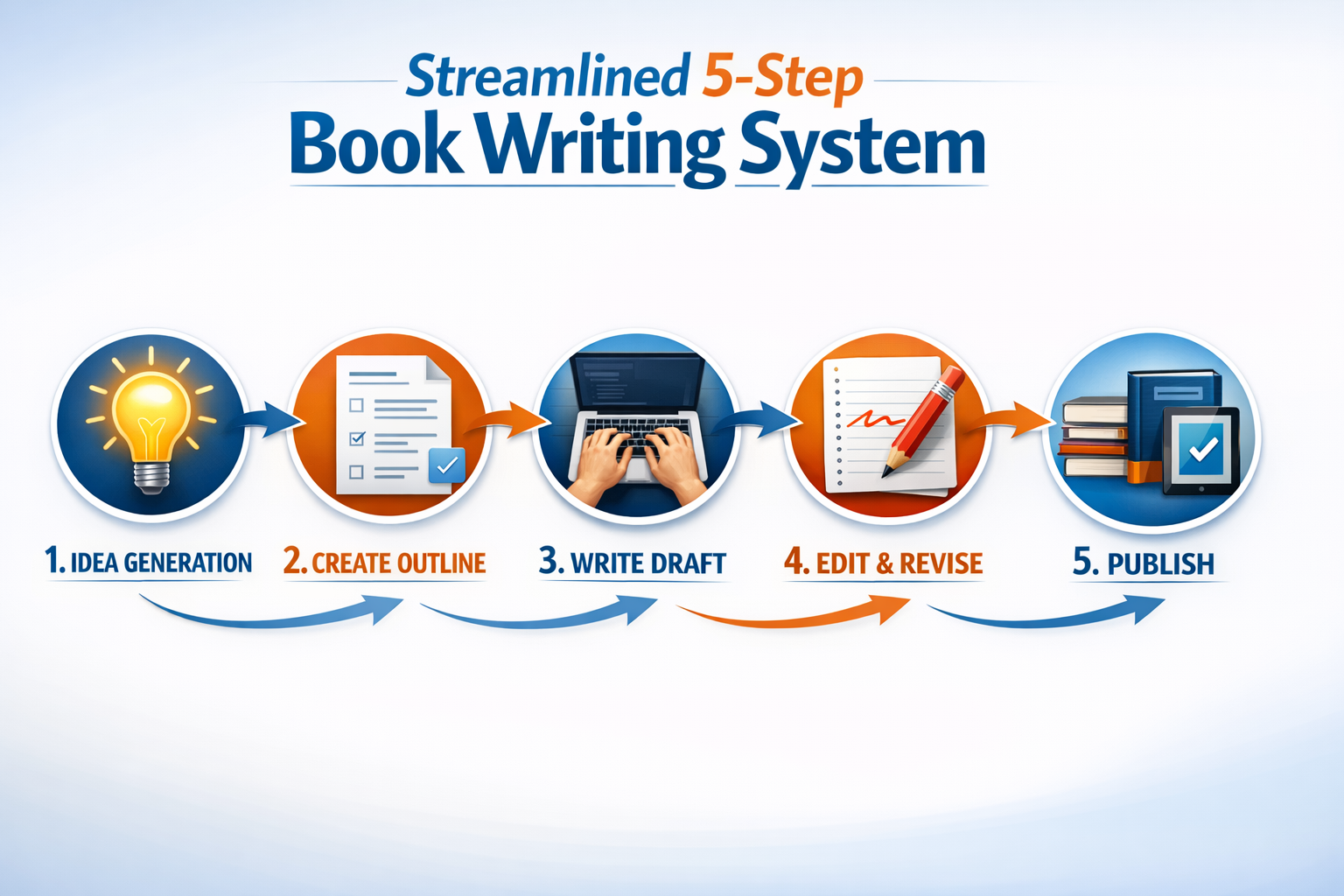
The 5-Step Fast-Track System:
- Choose a focused idea (1-2 days)
- Create a detailed outline (2-3 days)
- Write the first draft fast (14-60 days)
- Edit efficiently (7-14 days)
- Format and publish (3-7 days)
Total timeline: 4-12 weeks instead of years.
The magic happens when you focus on execution over perfection. Each step builds momentum for the next, creating a writing machine that produces finished books instead of endless drafts.
Most failed book projects die because authors try to perfect each chapter before moving forward. This system keeps you moving, builds confidence, and gets your book into readers’ hands quickly.
Step 1: Choose a Simple, Focused Book Idea
The biggest mistake new authors make? Choosing overly complex topics that require months of research and planning. When learning how to write a book quickly, simplicity is your friend.
Pick books with:
- One clear problem your book solves
- One specific audience who needs this solution
- Topics you already understand well
Examples of fast-to-write book ideas:
- “10 Time Management Tips for Working Moms”
- “Starting Your First Garden: A Beginner’s Guide”
- “How I Lost 50 Pounds in 6 Months”
- “5 Marketing Strategies That Doubled My Business”
Avoid these slow-writing traps:
- ❌ “The Complete Guide to Everything About…”
- ❌ Topics requiring extensive research
- ❌ Multiple audiences or problems
- ❌ Highly technical subjects you’re still learning
Why clarity speeds up writing: When you know exactly who you’re helping and what problem you’re solving, every chapter writes itself. You never stare at a blank page wondering what to say next.
Your book idea should pass the “elevator test”—you can explain it clearly in 30 seconds. If it takes longer, your topic is probably too complex for fast writing.
Remember: successful authors often write multiple short, focused books rather than one massive tome. Your first book doesn’t need to cover everything—it needs to help someone with something specific.
Step 2: Create a Detailed Outline (Your Speed Blueprint)
Spend time outlining to save time writing. This is the most important step in learning how to write a book quickly. A detailed outline eliminates writer’s block and turns writing into a simple fill-in-the-blanks exercise.
Your outline should include:
Chapter Level:
- Chapter titles
- Main point of each chapter
- 2-3 supporting points per chapter
Section Level:
- Bullet points for each major section
- Examples or stories to include
- Key takeaways for readers
Example outline structure:
Chapter 1: The Problem
• Why most people struggle with [topic]
• Story: My own struggle with this issue
• The cost of not solving this problem

Chapter 2: The Solution Overview
• Introduce your method/system
• Why it works better than alternatives
• What readers will achieve

Chapter 3-6: Step-by-step solution
• One main step per chapter
• How-to instructions
• Common mistakes to avoid
Pro tip: Write your outline as if you’re explaining your book to a friend. Use simple language and focus on helping your reader achieve their goal.
A good outline takes 2-3 days to create but saves weeks of writing time. When you sit down to write, you’ll know exactly what to say and in what order. No more staring at blank pages or wondering what comes next.
Effective planning is what separates authors who finish books quickly from those who struggle for years.
Step 3: Set a Daily Writing Goal
Consistency beats intensity. When learning how to write a book quickly, your daily writing habit matters more than occasional marathon sessions.
Recommended daily word counts:
- Beginners: 500-1,000 words (30-60 minutes)
- Intermediate: 1,000-2,000 words (60-90 minutes)
- Advanced: 2,000-3,000 words (90-120 minutes)
Time-based goals work too:
- Write for 30 minutes every morning
- One chapter per week
- Complete first draft in 30 days
Track your progress daily:
- Use a simple spreadsheet
- Note word count and time spent
- Celebrate small wins
Sample 30-day schedule for a 30,000-word book:
- Days 1-3: Complete outline
- Days 4-33: Write 1,000 words daily
- Total: 30,000 words in one month
The power of small daily goals: Writing 500 words daily produces a 15,000-word book in 30 days. That’s a complete short book or half of a full-length book. Most people underestimate what’s possible with consistent daily effort.
Remove decision fatigue: Write at the same time every day, in the same place, with the same routine. When writing becomes automatic, you’ll hit your daily goals without thinking about it.
Step 4: Write Fast Without Editing
The golden rule of fast writing: Don’t edit while you write. This single principle will double your writing speed and help you maintain momentum throughout your project.
Embrace imperfect first drafts:
- ✅ Focus on getting ideas down
- ✅ Use placeholder text for missing information
- ✅ Write “FIX LATER” for problem sections
- ❌ Don’t stop to find perfect words
- ❌ Don’t research facts while writing
- ❌ Don’t rewrite sentences immediately
Speed-writing techniques:
Voice typing:
- Use Google Docs voice typing
- Speak your book instead of typing
- Can double or triple your word count per hour
The “brain dump” method:
- Set a timer for 25 minutes
- Write continuously without stopping
- Don’t worry about grammar or structure
Use simple language:
- Write like you’re talking to a friend
- Avoid complex sentences
- Use active voice
Tools that can help:
- Grammarly: Catches basic errors without slowing you down
- Forest app: Blocks distracting websites
- Cold Turkey: Blocks social media during writing time
Remember: You can’t edit a blank page. A messy first draft is infinitely better than no draft at all. Professional writers know that all good writing happens in the editing phase—but you need raw material to work with first.
The editing mindset vs. writing mindset: These are two completely different mental modes. Writing is creative and expansive. Editing is analytical and restrictive. Trying to do both simultaneously kills your momentum and creativity.
Step 5: Use Time-Saving Writing Techniques
Work smarter, not harder. These proven techniques will help you write faster while maintaining quality.
🍅 The Pomodoro Technique:
- Write for 25 minutes
- Take a 5-minute break
- Repeat 2-4 cycles per writing session
- Prevents burnout and maintains focus
📝 Batch similar content:
- Write all your chapter introductions in one session
- Create all your examples together
- Write all conclusions at once
- Reduces mental switching between different types of content
🎯 Use templates and frameworks:
- Problem → Solution → Benefit structure
- Tell a story → Extract the lesson → Apply to reader
- Step 1 → Step 2 → Step 3 format
- Before → During → After progression
💬 Dictation for speed:
- Most people speak 3x faster than they type
- Use voice recording apps during commutes
- Transcribe later using Rev.com or Otter.ai
- Perfect for capturing ideas and rough content
🔄 Repurpose existing content:
- Blog posts can become book chapters
- Presentations can become book outlines
- Email newsletters contain book material
- Social media posts provide examples and stories
⚡ Power writing sessions:
- Turn off internet and phone
- Use a simple text editor (not Word)
- Set ambitious but achievable goals
- Reward yourself for hitting targets
The compound effect: Small improvements in your writing process create massive time savings. Writing 20% faster every day means finishing your book weeks earlier.
Developing consistent habits is more valuable than any single technique. Start with one or two methods and gradually add more as they become natural.
Step 6: Edit Quickly and Efficiently
Efficient editing is the final piece of learning how to write a book quickly. Most authors get stuck in endless editing cycles. This system helps you polish your book without perfectionist paralysis.
The 3-Pass Editing System:
Pass 1: Structure and Flow (2-3 days)
- Does each chapter serve the main goal?
- Is information in logical order?
- Are transitions between sections smooth?
- Remove or reorganize major sections
Pass 2: Clarity and Content (3-4 days)
- Is each sentence clear and easy to understand?
- Remove unnecessary words and phrases
- Add missing explanations or examples
- Ensure consistent tone throughout
Pass 3: Grammar and Polish (2-3 days)
- Fix spelling and grammar errors
- Check punctuation and formatting
- Read aloud to catch awkward phrasing
- Final proofread for typos
Time-saving editing tools:
- Grammarly Premium: Catches advanced grammar issues
- Hemingway Editor: Highlights complex sentences
- ProWritingAid: Comprehensive style checking
- Text-to-speech: Hear mistakes you miss when reading
Editing guidelines:
- ✅ Focus on clarity over perfection
- ✅ Cut ruthlessly—shorter is usually better
- ✅ Read from your ideal reader’s perspective
- ❌ Don’t edit the same section repeatedly
- ❌ Don’t add major new content during editing
- ❌ Don’t get stuck on minor word choices
When to stop editing: Your book is ready when it clearly communicates your message and helps your target reader. Perfect prose isn’t necessary—helpful content is.
Consider professional help: For your first book, consider hiring a professional editor for the final pass. This ensures quality while keeping you on schedule.
Step 7: Format and Publish Fast
Don’t let formatting and publishing slow down your momentum. Keep it simple and get your book into readers’ hands quickly.
Simple formatting approach:
- Use basic chapter headings
- Keep fonts and spacing consistent
- Add a simple table of contents
- Include basic front matter (title page, copyright)
Fast formatting tools:
- Canva: Simple book cover design
- Reedsy Design Editor: Free book formatting
- Draft2Digital: Automatic formatting for multiple platforms
- Amazon KDP: Built-in formatting tools
Self-publishing for speed:
Self-publishing gets your book published in days, not months or years. You maintain control and can start earning immediately.
Quick publishing platforms:
- Amazon KDP: Largest marketplace, easy setup
- Draft2Digital: Distributes to multiple stores automatically
- IngramSpark: Print-on-demand for physical books
- Gumroad: Direct sales to your audience
Don’t overcomplicate design:
- Simple, clean layouts work best
- Focus on readability over fancy formatting
- Test on different devices before publishing
- Remember: content matters more than design
Launch strategy:
- Start with ebook format for speed
- Add print version later if desired
- Plan your book launch while writing
- Begin marketing before publication
The goal is getting your valuable content to readers quickly, not creating a design masterpiece. You can always update and improve later versions.
Common Mistakes That Slow You Down
Avoid these speed-killers that derail most first-time authors:
🚫 Overthinking your idea
- Waiting for the “perfect” book concept
- Researching competitors endlessly
- Changing topics mid-project
- Solution: Pick a good idea and commit to finishing it
🚫 Writing without an outline
- Starting with just a vague concept
- Making up structure as you go
- Getting stuck on what comes next
- Solution: Spend 2-3 days creating a detailed outline
🚫 Editing too early
- Perfecting each paragraph before moving on
- Rewriting the same chapter repeatedly
- Losing momentum and motivation
- Solution: Complete the entire first draft before any editing
🚫 Waiting for motivation
- Only writing when you “feel inspired”
- Skipping days when motivation is low
- Relying on perfect conditions
- Solution: Write consistently regardless of how you feel
🚫 Perfectionist paralysis
- Believing your first book must be flawless
- Comparing your draft to published books
- Fear of publishing “imperfect” work
- Solution: Remember that done is better than perfect
🚫 Scope creep
- Adding new chapters mid-project
- Expanding your target audience
- Including too many topics
- Solution: Stick to your original outline and save new ideas for future books
The cost of these mistakes: Authors who make these errors typically take 2-5 years to complete their first book—if they finish at all. Following the proven system eliminates these roadblocks and keeps you moving forward.
Tips to Stay Consistent and Finish Faster
Consistency is the secret sauce of learning how to write a book quickly. These strategies help you maintain momentum from start to finish.
⏰ Write at the same time daily
- Morning sessions often work best (fresh mind)
- Block calendar time like an important meeting
- Protect your writing time from interruptions
- Build the habit through repetition
🎯 Remove distractions
- Turn off phone notifications
- Use website blockers during writing time
- Find a quiet space dedicated to writing
- Tell family/friends about your writing schedule
📉 Lower your expectations early
- Aim for “good enough” first drafts
- Focus on completion over perfection
- Remember you can always improve in editing
- Celebrate progress, not perfection
🏆 Create accountability
- Tell others about your book project
- Share daily word counts with a friend
- Join online writing communities
- Consider finding a writing partner
💪 Build momentum with small wins
- Celebrate hitting daily word goals
- Track your progress visually
- Reward yourself for weekly milestones
- Focus on the satisfaction of consistent progress
🔄 Develop writing rituals
- Same coffee, same music, same setup
- Review yesterday’s work briefly before starting
- End each session knowing what you’ll write next
- Make writing feel automatic and comfortable
When motivation fails (and it will):
- Write just 100 words to maintain the streak
- Remind yourself why this book matters
- Visualize holding your finished book
- Remember that professional writers write whether they feel like it or not
The compound effect of consistency: Writing 500 words daily for 60 days produces a 30,000-word book. Missing just two days per week cuts your progress in half.
How Long Does It Take to Write a Book Quickly?
Realistic timelines for learning how to write a book quickly:
📖 Short books (10,000-20,000 words):
- Outline: 1-2 days
- First draft: 10-20 days (500-1,000 words daily)
- Editing: 3-5 days
- Formatting/Publishing: 2-3 days
- Total: 2-4 weeks
📚 Medium books (30,000-40,000 words):
- Outline: 2-3 days
- First draft: 30-40 days (1,000 words daily)
- Editing: 7-10 days
- Formatting/Publishing: 3-5 days
- Total: 6-8 weeks
📖 Full-length books (50,000+ words):
- Outline: 3-5 days
- First draft: 50-75 days (1,000 words daily)
- Editing: 10-14 days
- Formatting/Publishing: 5-7 days
- Total: 10-14 weeks
Factors that affect speed:
- Writing experience: First-time authors may need more time
- Topic complexity: Simple how-to guides write faster than research-heavy topics
- Available time: More daily writing time = faster completion
- Consistency: Regular daily writing beats sporadic long sessions
Real-world examples:
- Stephen King wrote Carrie in 3 months
- Jack Kerouac wrote On the Road in 3 weeks (though he outlined for years)
- Many successful business books are written in 30-60 days
The key insight: Consistency determines speed more than talent or experience. An author writing 500 words daily will finish faster than someone writing 2,000 words once per week.
Your first book will likely take longer as you learn the process. Your second and third books will be much faster as you refine your system and build confidence.
Conclusion
Learning how to write a book quickly isn’t about rushing or cutting corners—it’s about having a proven system that eliminates confusion and keeps you moving forward. The strategies in this guide have helped thousands of first-time authors complete their books in weeks instead of years.
Remember the key principles:
- Speed comes from structure: A detailed outline eliminates writer’s block
- Consistency beats intensity: Daily writing habits produce finished books
- Separate writing from editing: First drafts should be messy and imperfect
- Simple ideas work best: Focused topics are easier to write and more valuable to readers
Your next steps:
- Choose your book idea today (use the simple, focused approach)
- Create a detailed outline this week (spend 2-3 days getting this right)
- Set your daily writing goal (start with 500-1,000 words)
- Begin writing tomorrow (don’t wait for perfect conditions)
- Track your progress daily (celebrate small wins along the way)
The difference between aspiring authors and published authors isn’t talent—it’s having a system and following it consistently. You now have that system.
Your book is waiting to be written. The only question is: will you start today or keep waiting for someday?
Take action now: Open a document, write your book title, and begin your outline. Your future self will thank you for starting today.
Whether you’re planning to self-publish or pursue traditional publishing, completing your manuscript quickly builds momentum and confidence for your entire writing career. The world needs your unique knowledge and perspective—don’t keep readers waiting any longer.
FAQ
What is the fastest way to write a book?
The fastest way combines a detailed outline, consistent daily writing (1,000+ words), and separating writing from editing. Most authors can complete a book in 30-90 days using this system.
Can I write a book in a week?
Yes, for short books (10,000-15,000 words). This requires writing 1,500-2,000 words daily with a pre-existing outline and dedicated focus time.
How many words should I write per day?
Beginners should aim for 500-1,000 words daily (30-60 minutes). Experienced writers can target 1,000-3,000 words per day for faster completion.
Is it okay to write a book quickly?
Absolutely. Many successful books were written quickly. Speed prevents overthinking and maintains momentum. Quality comes from editing, not slow writing.
Should I use AI to speed up writing?
AI can help with outlines, brainstorming, and editing suggestions, but your unique voice and expertise should drive the content. Use AI as a tool, not a replacement for your ideas.


