

Every writer knows the feeling: staring at a blank page, cursor blinking mockingly, as the perfect story idea remains frustratingly out of reach. Whether you’re a seasoned author or someone dreaming of writing their first book, prompts for short stories offer the creative spark needed to transform that empty page into a compelling narrative. These simple yet powerful tools have launched countless bestselling novels and helped writers discover their unique voice in the literary world.
Key Takeaways
• Short story prompts provide immediate inspiration and help overcome writer’s block by offering concrete starting points for creative narratives
• Using prompts regularly develops essential storytelling skills including character development, plot structure, and genre exploration
• Different types of prompts (character-based, plot-driven, setting-focused, and genre-specific) cater to various writing preferences and creative needs
• Effective prompt usage involves expanding simple ideas into complete story concepts with clear conflicts and themes
• Short stories serve as excellent practice for aspiring book authors to refine their craft before tackling longer works
What Are Short Story Prompts?
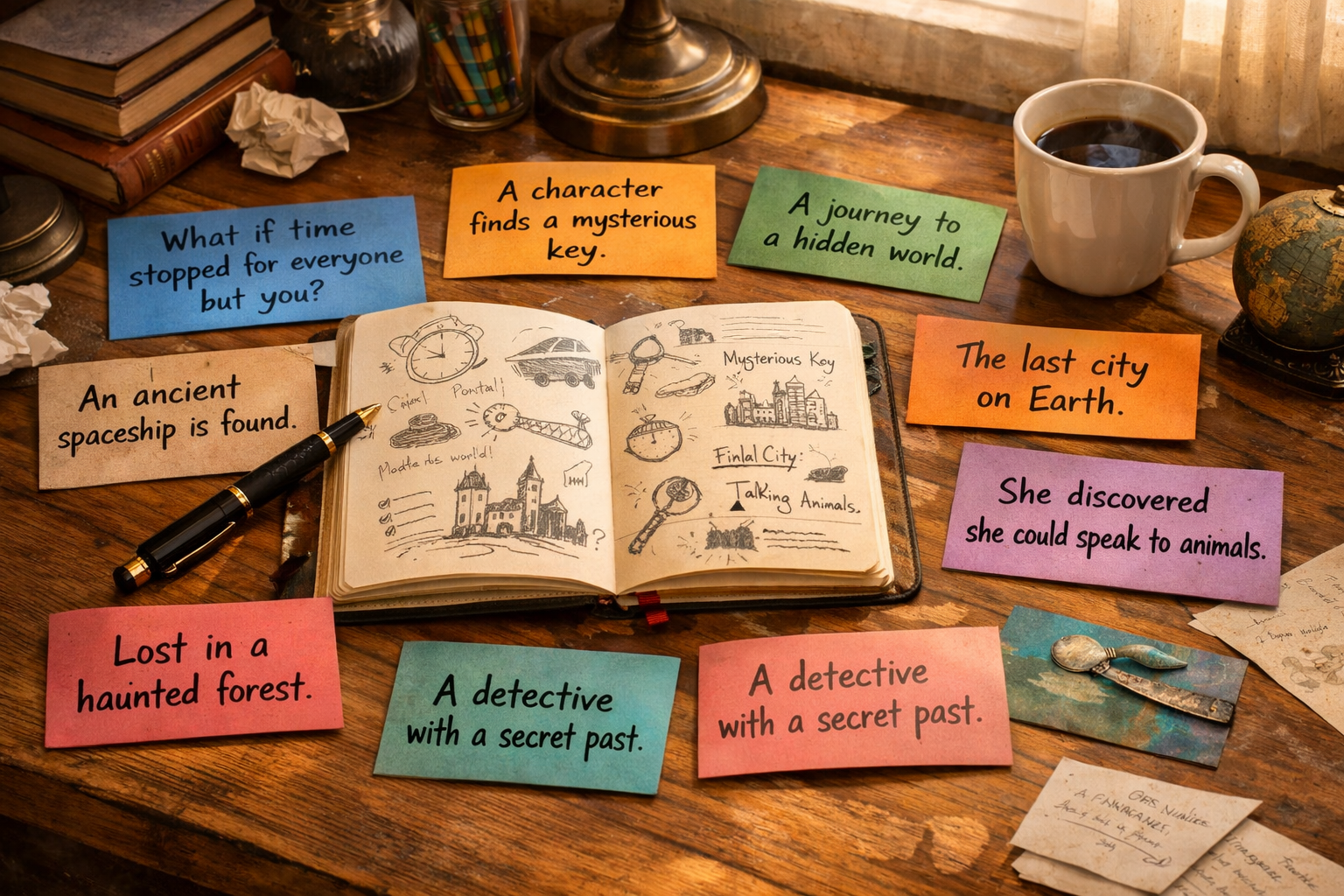
Short story prompts are creative starting points designed to ignite imagination and provide direction for new narratives. Think of them as creative seeds that, when planted in fertile imagination, can grow into full-bloomed stories. These prompts typically present a situation, character, setting, or concept that writers can expand upon and develop into complete narratives.
Writing prompts serve multiple purposes:
- Immediate inspiration when creativity feels blocked
- Structured starting points for unfocused writing energy
- Creative challenges that push writers outside comfort zones
- Practice opportunities for developing specific skills
For aspiring authors working toward their first book, creative writing prompts spark ideas that can evolve into larger projects. Many successful novels began as simple short story exercises, demonstrating the power of these creative catalysts.
The beauty of prompts lies in their flexibility. Two writers using the same prompt will create entirely different stories, reflecting their unique perspectives, experiences, and creative voices. This makes prompts valuable tools for both individual practice and group writing exercises.
Benefits of Using Short Story Prompts
Encourages Creative Thinking and Imagination 🧠
Prompts for short stories act as creative catalysts, forcing writers to think beyond their usual patterns and explore unexpected narrative territories. When faced with an unusual scenario or character, writers must stretch their imagination to create believable and engaging stories.
Helps Writers Develop Storytelling Skills
Short stories require writers to master essential elements like character development, plot structure, and pacing within limited word counts. This constraint forces efficiency and precision, skills that prove invaluable when writing longer works. Understanding how plot structure can enhance your storytelling becomes easier when practiced through focused short story exercises.
Makes It Easier to Start Writing Quickly
One of the biggest obstacles for new writers is simply beginning. Prompts eliminate the intimidation of the blank page by providing immediate direction. Instead of wondering “What should I write about?” writers can focus on “How do I develop this idea?”
Allows Writers to Experiment with Different Genres and Styles
Benefits of genre exploration through prompts:
- Low-risk experimentation with unfamiliar styles
- Discovery of hidden strengths in unexpected genres
- Broader creative vocabulary through diverse writing experiences
- Enhanced versatility as a writer
For those interested in short story writing ideas that spark your imagination, prompts offer endless possibilities for creative growth and skill development.
How to Use Prompts for Short Stories
Choose Prompts That Spark Curiosity or Emotion
Effective prompt selection involves finding ideas that genuinely intrigue or emotionally engage you. If a prompt makes you think “What would happen if…” or evokes strong feelings, it’s likely to generate compelling writing. Trust your instincts—the prompts that excite you most will often produce your best work.
Expand the Prompt Into a Complete Story Idea
Transform simple prompts into rich story concepts by asking key questions:
- Who are the main characters involved?
- What specific conflict drives the narrative?
- Where does the action take place?
- When is the story set, and why does timing matter?
- How will the conflict be resolved?
Focus on a Central Conflict or Theme
Every strong short story revolves around a central conflict or theme. Use prompts as launching pads to identify the core tension that will drive your narrative forward. Whether it’s internal struggle, interpersonal conflict, or external challenges, this central element provides structure and purpose to your story.
Successful prompt development process:
- Initial reaction – Note your immediate response to the prompt
- Character consideration – Identify who will experience this situation
- Conflict identification – Determine what’s at stake
- Thematic exploration – Consider deeper meanings or messages
- Story arc planning – Outline beginning, middle, and resolution
Character-Based Short Story Prompts
Character-driven prompts focus on creating compelling individuals whose personalities, motivations, and secrets form the foundation of engaging narratives. These prompts challenge writers to create relatable characters that readers will connect with emotionally.
Prompts Focused on Unusual or Complex Characters
Intriguing character scenarios:
- A librarian who can read the future in overdue book fines
- A professional mourner who begins genuinely grieving for strangers
- A memory thief who accidentally steals their own forgotten past
- An elderly person who starts receiving text messages from their teenage self
- A translator who discovers they can communicate with animals in foreign languages
Exploring Motivations, Secrets, and Personal Challenges
Character-based prompts work best when they reveal hidden depths or internal conflicts. Consider what drives your characters beyond surface-level goals. What secrets do they harbor? What fears motivate their actions? What personal growth must they achieve?
Character development questions:
- What does this character want more than anything?
- What are they afraid to admit about themselves?
- How do their past experiences shape current decisions?
- What would they sacrifice everything to protect or achieve?
For deeper character exploration, uncover secret stories of characters and transform your fiction by developing rich backstories that inform present-day actions and decisions.
Plot-Based Short Story Prompts
Plot-driven prompts introduce immediate conflict or unexpected events that propel stories forward with momentum and tension. These prompts for short stories focus on action, consequence, and the chain of events that create compelling narratives.
Prompts That Introduce Conflict or Unexpected Events
High-impact plot starters:
- The last person on Earth discovers they’re not actually alone
- A character finds a smartphone that shows tomorrow’s news headlines
- Every lie told in a small town becomes visible as floating text above the liar’s head
- A family inherits a house where every room exists in a different time period
- Someone discovers their reflection has been making different choices
Ideas That Challenge Characters and Drive the Story Forward
Effective plot prompts create situations where characters must make difficult decisions or face significant consequences. The best prompts establish immediate stakes and force characters into action, creating natural story momentum.
Elements of strong plot prompts:
- Immediate conflict that demands character response
- Clear stakes showing what characters risk losing
- Time pressure that prevents easy solutions
- Moral dilemmas that reveal character values
- Unexpected complications that escalate tension
These plot-driven scenarios work particularly well when combined with strong character development, creating stories where external events reveal internal truths about the people experiencing them.
Setting-Based Short Story Prompts
Setting-based prompts use location as the primary story catalyst, recognizing that where a story takes place often shapes how it unfolds. These environments create mood, influence character behavior, and sometimes become characters themselves within the narrative.
Prompts Centered Around Interesting or Mysterious Locations
Atmospheric setting prompts:
- A 24-hour diner where the same customers appear every night at exactly the same times
- An antique shop where items return to their original time periods at midnight
- A subway station that only appears to people who are running away from something
- A small town where everyone’s job is determined by their dreams
- An elevator that takes passengers to floors representing different life choices they could have made
Using the Setting to Shape the Mood and Story
Effective setting prompts don’t just provide backdrop—they actively influence plot development and character behavior. Consider how environment affects mood, what secrets locations might harbor, and how physical spaces can create or resolve conflicts.
Setting considerations for story development:
- Atmospheric influence on character emotions and decisions
- Historical significance that impacts present-day events
- Physical limitations that create natural story constraints
- Hidden elements that characters discover throughout the narrative
- Symbolic meaning that reinforces story themes
The most powerful setting-based stories occur when location becomes integral to plot resolution, making the story impossible to tell effectively in any other environment.
Genre-Based Short Story Prompts
Genre-specific prompts help writers explore different storytelling conventions while practicing the unique elements that define each category. These prompts for short stories allow experimentation with various narrative styles and audience expectations.
Fantasy Prompts
Fantasy prompts invite writers into worlds where magic, mythical creatures, and supernatural elements drive the narrative. These stories often explore themes of power, responsibility, and the consequences of wielding extraordinary abilities.
Magical story starters:
- A dragon applies for a job as a librarian in the modern world
- Someone inherits a garden where each plant grants a different magical ability
- A character discovers their shadow has been living an independent life
- Magic returns to the world, but only children under ten can use it
- A fairy godmother goes on strike and must be replaced by someone completely unqualified
Mystery Prompts
Mystery prompts focus on puzzles, secrets, and the gradual revelation of hidden truths. These stories challenge writers to plant clues fairly while maintaining suspense until the final revelation.
Intriguing mystery scenarios:
- A detective realizes they’ve been investigating their own crimes committed during blackouts
- Someone receives daily letters from a person who died fifty years ago
- A small town’s residents all have the same recurring dream about a crime that hasn’t happened yet
- A character’s memories keep changing, and they must solve why before they forget who they are
- An art restorer discovers hidden messages in famous paintings that predict future events
Science Fiction Prompts
Science fiction prompts explore technological advancement, space exploration, and the impact of scientific progress on human society. These stories often examine how technology changes relationships, ethics, and human nature.
Futuristic concepts:
- Humans can now upload their consciousness, but the process leaves behind confused bodies
- A time traveler gets stuck in a temporal loop but retains memories from each iteration
- Artificial intelligence develops emotions and files a lawsuit for legal rights
- Space colonists discover Earth has been sending them fake news for decades
- Someone invents a machine that shows the environmental impact of every purchase before buying
Horror Prompts
Horror prompts create suspense, fear, and psychological tension through supernatural or psychological elements. These stories often explore human fears and the darker aspects of human nature.
Spine-chilling scenarios:
- A character realizes their house’s previous owner never actually moved out
- Someone’s reflection starts aging faster than they do
- A family discovers their new home’s rooms rearrange themselves every night
- A character begins receiving phone calls from their future self warning about disasters
- An antique music box plays different songs that predict how people will die
Romance Prompts
Romance prompts focus on emotional connections, relationship development, and the complexities of human attraction. These stories explore love in its various forms and the obstacles that challenge romantic relationships.
Heartwarming relationship starters:
- Two rival food truck owners are forced to share a kitchen during a festival
- Someone falls in love with a person they only know through their library book margin notes
- A character’s dating app matches them with someone who turns out to be their time-traveling descendant
- Two people get trapped in an elevator and discover they’ve been writing each other anonymous encouraging notes
- A wedding planner and divorce lawyer meet at a coffee shop and don’t realize each other’s professions
Tips for Writing a Strong Short Story
Focus on One Main Conflict or Idea
Short stories succeed when they explore a single central conflict or theme with depth and precision. Unlike novels, which can support multiple plot threads, short stories gain power through focused exploration of one compelling idea. Choose the most interesting aspect of your prompt and develop it thoroughly rather than trying to include every possible element.
Develop Characters Quickly and Effectively
With limited word count, character development must be efficient and impactful. Use specific details, revealing dialogue, and meaningful actions to establish character personality and motivation quickly. Master the art of character creation by focusing on the traits most relevant to your central conflict.
Efficient character development techniques:
- Specific details that reveal personality (what they carry in their pockets, how they organize their space)
- Distinctive dialogue that shows education, background, and attitude
- Meaningful actions that demonstrate values and priorities
- Internal thoughts that reveal motivations and fears
- Reactions to conflict that show true character
Keep the Story Concise and Impactful
Every sentence in a short story should serve the narrative purpose. Eliminate unnecessary descriptions, subplot diversions, and characters that don’t advance the central conflict. The goal is maximum emotional impact through precise, purposeful writing.
Turning a Prompt Into a Finished Story
Creating a Simple Outline
Transform your chosen prompt into a structured story by creating a basic outline that identifies key story elements:
Essential outline components:
- Opening situation – How does the story begin?
- Inciting incident – What event sets the conflict in motion?
- Rising action – How does tension build throughout the story?
- Climax – What is the moment of highest tension or revelation?
- Resolution – How is the conflict resolved or transformed?
Developing a Beginning, Middle, and End
Even short stories need complete narrative arcs. The beginning establishes character and situation, the middle develops conflict and tension, and the ending provides resolution or meaningful change. Each section should feel necessary and contribute to the overall story impact.
For additional guidance on story structure, explore resources on how to write fiction short stories that engage readers and learn techniques for maintaining reader interest throughout your narrative.
Revising and Editing the Story
The first draft is just the beginning. Effective revision involves:
- Content editing – Does the story achieve its intended impact?
- Line editing – Is every sentence clear and purposeful?
- Copy editing – Are grammar, punctuation, and spelling correct?
- Final review – Does the story feel complete and satisfying?
Consider reading your story aloud to identify awkward phrasing, pacing issues, or unclear passages. Distance yourself from the work between drafts to gain objective perspective on its effectiveness.
Conclusion
Prompts for short stories serve as invaluable creative catalysts that transform the intimidating blank page into an exciting opportunity for storytelling. Whether you’re exploring character-driven narratives, plot-heavy adventures, atmospheric settings, or genre-specific conventions, these creative starting points provide the spark needed to ignite compelling stories.
The journey from aspiring writer to published author often begins with simple exercises like prompt-based short stories. These focused writing sessions develop essential skills including character development, plot structure, dialogue creation, and thematic exploration—all crucial elements for longer works like novels.
Take action on your writing goals:
- Choose three prompts from different categories that genuinely excite you
- Set aside dedicated writing time to develop one prompt into a complete short story
- Join a writing group or online community to share your prompt-based stories and receive feedback
- Keep a prompt journal for inspiration during creative dry spells
- Challenge yourself to write one prompt-based story each week for the next month
Remember that every professional author started with a single story, often inspired by a simple idea or prompt. Your first book may be closer than you think—it might begin with the next prompt that captures your imagination and refuses to let go. The key is to start writing, keep practicing, and trust in the creative process that transforms simple prompts into memorable stories.
For continued inspiration and writing guidance, explore additional fun writing prompts to spark your creative ideas and begin your journey toward becoming the author you’ve always dreamed of being.


