

Every human being is born with stories inside them, waiting to be told. Yet when aspiring writers sit down with a blank page, many feel overwhelmed and don’t know where to start. The secret lies in understanding that writing a story examples can serve as your roadmap to crafting compelling narratives that captivate readers from the first sentence to the last.
Whether you dream of writing the next bestselling novel or simply want to share meaningful stories with friends and family, learning the fundamentals of storytelling will transform your writing journey. This comprehensive guide provides clear writing a story examples alongside proven techniques that make the process both enjoyable and achievable.
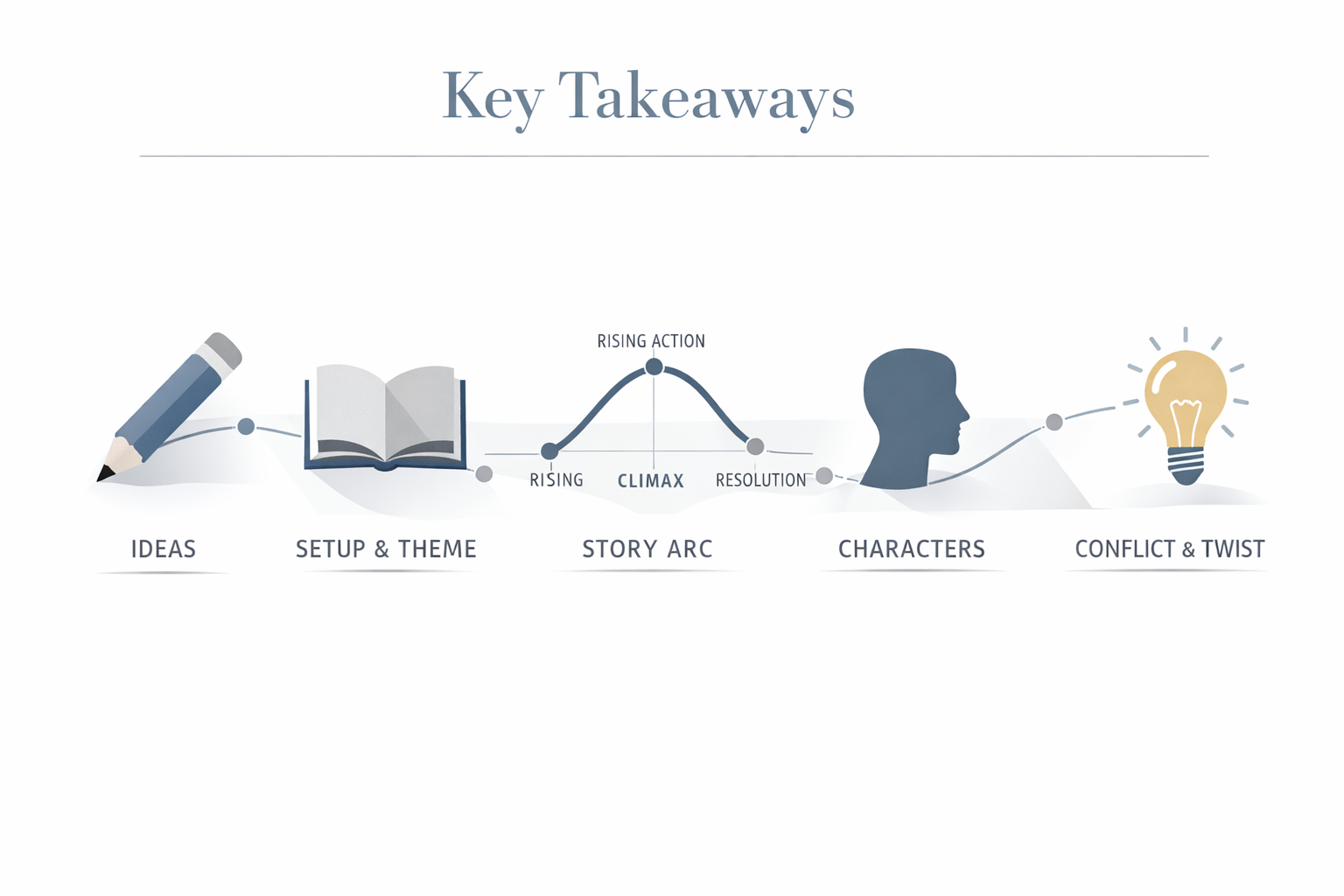
Key Takeaways
• Story structure follows a simple pattern: Every great story has a beginning (setup), middle (conflict), and end (resolution) that work together to create a satisfying narrative arc.
• Start with relatable characters and clear conflicts: The best stories feature characters readers care about facing problems they can understand and connect with emotionally.
• Practice with short examples first: Beginning writers should focus on crafting brief, complete stories before attempting longer works to master the essential storytelling elements.
• Show don’t tell through action and dialogue: Effective stories reveal character emotions and plot developments through what characters do and say rather than lengthy descriptions.
• Every story needs a clear resolution: Readers expect conflicts to be resolved in a way that feels earned and satisfying, even if the ending isn’t entirely happy.
What Is Story Writing?
Definition of Story Writing
Story writing is the art of creating a narrative that takes readers on a journey through carefully crafted characters, settings, and events. At its core, a story is a sequence of connected events that reveals how characters respond to challenges and change over time. Unlike other forms of writing, stories focus on showing human experiences through action, dialogue, and emotion.
Stories serve multiple purposes in our lives. They entertain us during leisure time, educate us about different perspectives and experiences, and help us communicate complex ideas in memorable ways. From ancient oral traditions to modern digital media, storytelling remains one of humanity’s most powerful tools for connection and understanding.
Key Elements of a Good Story
Every compelling story contains five essential elements that work together to create an engaging reading experience:
Characters 👥 – The people (or animals, creatures, etc.) who drive the story forward through their actions and decisions. Strong characters have clear motivations, distinct personalities, and the ability to grow and change.
Setting 🏞️ – The time and place where the story unfolds. This includes not just physical locations but also the social, cultural, and historical context that influences character behavior.
Conflict or Problem ⚡ – The central challenge or obstacle that creates tension and drives the plot. Without conflict, there’s no story—just a series of events.
Rising Action 📈 – The series of events that build tension and complicate the main conflict, leading toward the story’s climax.
Resolution ✅ – The conclusion where the main conflict is addressed and the story reaches a satisfying endpoint.
Understanding these elements helps writers create stories that captivate readers and leave lasting impressions.
Basic Structure of a Story
Beginning
The opening of your story serves as the foundation for everything that follows. In the beginning, you must introduce your main characters in a way that makes readers care about what happens to them. This doesn’t mean providing their entire life history—instead, show them in action, making decisions that reveal their personality and values.
Next, describe the setting efficiently. Readers need enough detail to visualize where and when the story takes place, but avoid overwhelming them with lengthy descriptions. Focus on details that affect the plot or reveal character.
Most importantly, present the main problem or conflict that will drive your story forward. This conflict should feel significant to your main character and create questions in the reader’s mind about how things will turn out.
Middle
The middle section is where your story gains momentum and complexity. Here, the conflict becomes more complicated as new obstacles emerge and stakes increase. Your character’s initial attempts to solve the problem may fail or create additional challenges.
During this phase, the character faces increasingly difficult challenges that test their resolve, skills, and values. Each obstacle should feel like a natural consequence of previous events while pushing the character closer to a breaking point.
This section often contains the story’s climax—the moment of highest tension where the main conflict reaches its peak intensity.
Ending
A strong ending resolves the conflict in a way that feels both surprising and inevitable. The resolution should grow naturally from the character’s actions and choices throughout the story, not from coincidence or luck.
The story reaches a satisfying conclusion when readers feel that the character’s journey has been worthwhile and that they’ve learned something meaningful about life, relationships, or human nature.
For more detailed guidance on story structure, explore our comprehensive guide on steps to writing a story effectively.
Writing a Story Examples: Three Complete Narratives
Example #1: The Lost Key (Short Story)
Sarah rushed through her apartment, checking every surface twice. Her job interview started in twenty minutes, and her car keys had vanished. She’d already missed two buses while searching. Panic rising, she called her neighbor Tom, who found her keys in his mailbox—apparently dropped there during yesterday’s mail chaos. Tom drove her to the interview, where she arrived flustered but on time. The interviewer smiled, saying they appreciated candidates who could handle unexpected challenges gracefully. Sarah got the job.
Breakdown of the Story:
- Character: Sarah, someone facing a common but stressful situation
- Conflict: Lost keys threatening an important job interview
- Resolution: Community help and personal resilience lead to success
This example demonstrates how everyday problems can create compelling stories when they threaten something important to the character.
Example #2: The Cave Discovery (Adventure Story)
Twelve-year-old Marcus followed the narrow trail behind his grandmother’s house, discovering a hidden cave entrance partially covered by fallen branches. Inside, his flashlight revealed ancient drawings covering the walls—handprints, animals, and symbols he’d never seen. Excited, he rushed home to tell his grandmother, who smiled knowingly. She explained that her grandfather, a local tribal elder, had shown her the same cave sixty years ago. Together, they contacted the tribal council, who thanked Marcus for protecting this sacred site and invited him to learn about his heritage.
What Makes This Story Interesting:
- Suspense: The mystery of the cave creates immediate intrigue
- Character decisions: Marcus chooses to share his discovery rather than keep it secret
- Rising tension: Each revelation builds toward a meaningful conclusion
Example #3: The Burnt Dinner (Personal Experience Story)
Maria’s first attempt at cooking for her boyfriend’s parents turned into a disaster when the smoke alarm shrieked and black smoke poured from the oven. Her carefully planned lasagna had become charcoal. Fighting back tears, she called for pizza delivery while opening windows. When David’s parents arrived to find her laughing at the mess, his mother hugged her and shared stories of her own cooking catastrophes. They spent the evening eating pizza, sharing embarrassing stories, and bonding over imperfection. Maria realized that authenticity mattered more than perfection.
Why Personal Stories Work:
- Relatable: Most people have experienced cooking disasters
- Emotional connection: Readers empathize with Maria’s embarrassment and relief
- Realistic events: The situation feels genuine and unforced
These writing a story examples illustrate how different genres and approaches can create engaging narratives that resonate with readers.
Step-by-Step Guide to Writing Your Own Story
Step 1: Choose a Simple Idea
Begin with a small concept or situation that interests you. Avoid complex plots with multiple storylines—instead, focus on one clear situation or problem. Ask yourself: “What if…?” or “What would happen if…?”
Some starter ideas:
- A character finds something unexpected
- Someone faces a fear they’ve been avoiding
- A misunderstanding leads to complications
- A character must choose between two important things
Step 2: Create a Main Character
Give them a goal or problem that matters to them personally. Your character doesn’t need to be extraordinary—ordinary people facing meaningful challenges often make the most compelling protagonists.
Consider:
- What does your character want most?
- What’s preventing them from getting it?
- What would happen if they fail?
- What makes them unique or interesting?
For deeper character development, check out our guide on creating relatable characters.
Step 3: Build the Conflict
Introduce obstacles or challenges that prevent your character from easily achieving their goal. Conflict can be:
- External: Other people, nature, society, or circumstances
- Internal: Fear, doubt, moral dilemmas, or personal limitations
- Interpersonal: Relationship problems or communication issues
The best stories often combine multiple types of conflict.
Step 4: Develop the Story
Show how the character reacts to the problem through their actions, dialogue, and decisions. Avoid simply telling readers what happens—instead, let them experience events through scenes that reveal character and advance the plot.
Focus on:
- What your character does (actions)
- What they say (dialogue)
- How they feel (emotions shown through behavior)
- How the situation changes based on their choices
Step 5: Write the Ending
Resolve the conflict clearly in a way that feels earned by your character’s efforts throughout the story. The resolution doesn’t have to be completely happy, but it should feel satisfying and complete.
Strong endings often:
- Show how the character has changed or grown
- Resolve the main conflict definitively
- Leave readers with something to think about
- Feel surprising yet inevitable
For additional storytelling techniques, explore our resource on plot structure enhancement.
Tips for Writing Better Stories
Keep sentences simple and clear ✏️
Write in a way that flows naturally and doesn’t distract from your story. Vary sentence length to create rhythm, but prioritize clarity over complexity.
Focus on emotions and actions 💭
Readers connect with stories through feelings and movement. Show characters experiencing emotions through their behavior rather than stating “she was sad” or “he felt angry.”
Show instead of just telling 🎭
Instead of writing “John was nervous,” show his nervousness: “John’s hands trembled as he straightened his tie for the third time.” This technique makes stories more vivid and engaging.
Practice writing short stories regularly 📝
Like any skill, storytelling improves with practice. Set aside time each week to write brief stories, experimenting with different characters, settings, and conflicts.
Additional techniques for improvement include developing a consistent writing habit and exploring creative writing exercises that challenge your skills.
Common Mistakes Beginners Make
Too many characters 👥
New writers often introduce numerous characters, confusing readers and diluting focus. Start with one or two main characters and develop them thoroughly before adding others.
No clear conflict ❌
Stories without meaningful problems become boring quickly. Ensure your character faces genuine obstacles that matter to them personally.
Weak endings 📉
Rushed or unsatisfying conclusions disappoint readers. Take time to craft resolutions that feel complete and earned by your character’s journey.
Stories that lack structure 🏗️
Without clear beginning, middle, and end, stories feel aimless. Even experimental narratives benefit from underlying structure that guides readers through the experience.
Learning to avoid these pitfalls while studying successful writing a story examples will accelerate your development as a storyteller.
Conclusion
Learning to write compelling stories is an achievable goal for anyone willing to practice and study effective techniques. The writing a story examples presented in this guide demonstrate that powerful narratives can emerge from simple situations when they’re structured thoughtfully and focus on character-driven conflicts.
Remember that every professional writer started as a beginner, learning through trial, error, and persistent practice. The five-step process outlined here—choosing a simple idea, creating a compelling character, building meaningful conflict, developing through action, and crafting satisfying resolutions—provides a reliable framework for your storytelling journey.
Your next step: Choose one of the story ideas that excited you while reading this article and spend the next hour writing a complete short story using the techniques you’ve learned. Don’t worry about perfection—focus on creating a beginning, middle, and end that feels satisfying to you.
As you continue developing your craft, remember that great stories come from observing life carefully, understanding human nature deeply, and practicing regularly. Whether you’re writing for personal enjoyment or aspiring to publication, these fundamental skills will serve as the foundation for all your future storytelling adventures.
Start writing today, and discover the unique stories only you can tell.


