

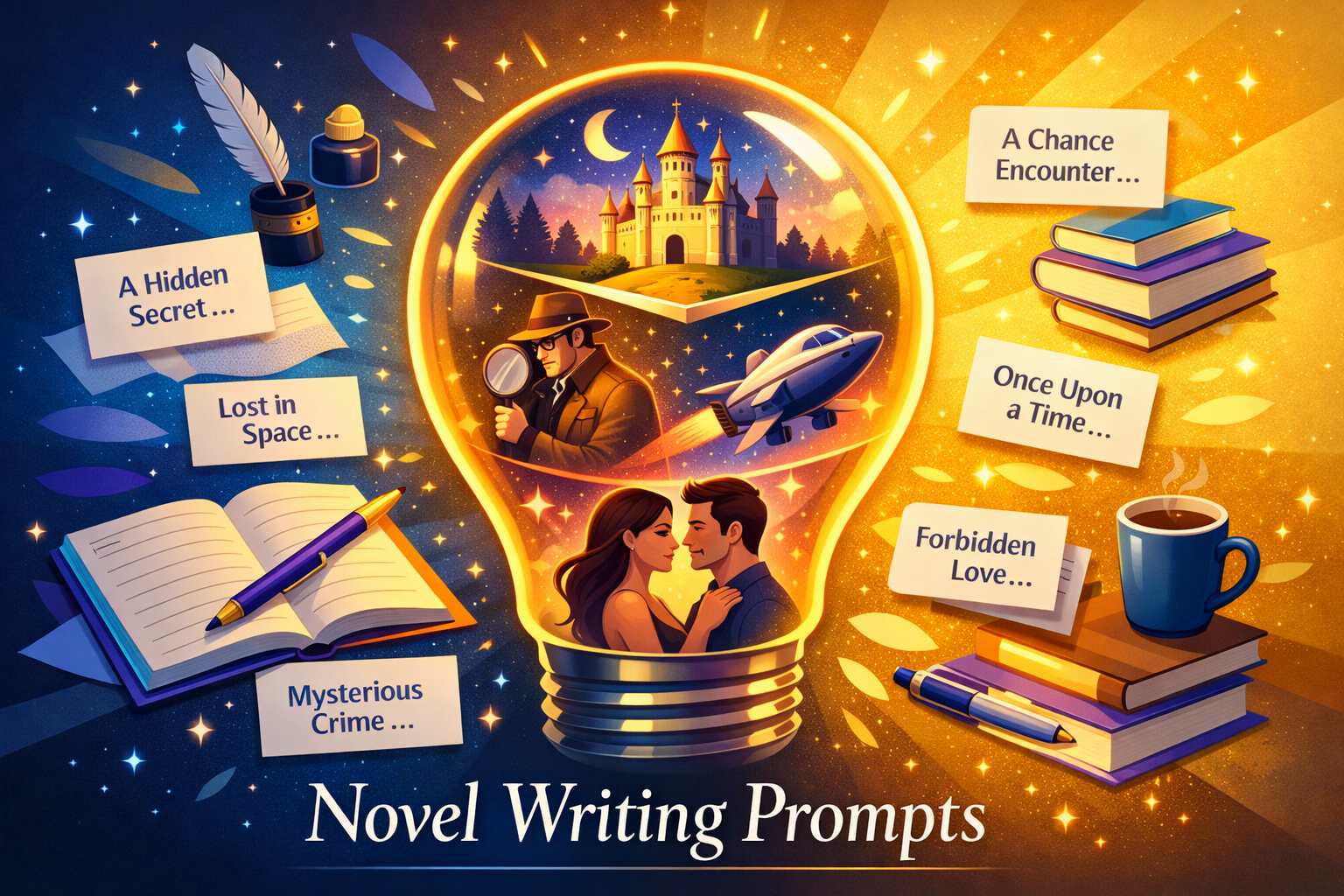
Every aspiring novelist has faced the dreaded blank page—that intimidating white space where stories should bloom but often remain stubbornly empty. In 2026, with countless stories already told, finding fresh inspiration for your debut novel can feel overwhelming. Yet the secret to unlocking your creativity might be simpler than you think: Writing Prompts for Novels offer a powerful gateway to transform scattered ideas into compelling narratives that captivate readers.
Key Takeaways
• Writing prompts serve as creative catalysts that transform vague ideas into concrete story foundations
• Different prompt types (character, plot, setting, genre-specific) address various aspects of novel development
• Effective prompt usage involves expanding initial concepts into full character arcs, conflicts, and world-building
• Regular prompt practice strengthens storytelling skills and helps overcome writer’s block
• Simple prompts can evolve into complex, publishable novels with proper development and planning
What Are Novel Writing Prompts?
Novel writing prompts are creative starting points designed to spark imagination and generate story ideas. Unlike short story prompts that focus on single scenes or moments, novel prompts provide the foundation for longer narratives with complex characters, multiple plot threads, and rich world-building.
These prompts typically present a situation, character, or concept that raises questions demanding exploration. For example: “A librarian discovers that certain books in their collection can transport readers into the stories themselves—but some visitors never return.” This prompt immediately suggests character motivations, potential conflicts, and world-building opportunities.
Why prompts work effectively:
- They bypass the paralysis of infinite possibilities
- They provide concrete starting points for abstract creativity
- They challenge writers to explore unfamiliar territories
- They offer structure while maintaining creative freedom
For aspiring novelists, prompts eliminate the overwhelming question of “What should I write about?” and replace it with the more manageable challenge of “How do I develop this idea?”
Benefits of Using Writing Prompts for Novels
🎯 Encourages Creative Thinking
Writing prompts push writers beyond their comfort zones, forcing exploration of themes, genres, and perspectives they might never consider independently. A fantasy writer might discover their talent for mystery through a prompt combining magical elements with detective work.
💡 Generates Fresh Story Ideas
Even experienced writers occasionally struggle with idea generation. Creative writing prompts spark ideas by presenting unexpected combinations of elements, helping writers discover unique angles on familiar themes.
📝 Reduces Starting Pressure
The blank page intimidates because it represents unlimited possibilities. Prompts narrow focus to manageable scope, allowing writers to begin immediately rather than spending hours deciding what to write.
🏋️ Improves Storytelling Skills
Regular prompt practice develops crucial writing muscles: character development, dialogue, pacing, and conflict resolution. Each prompt presents new challenges that strengthen overall storytelling abilities.
🚫 Overcomes Writer’s Block
When inspiration runs dry, prompts provide external motivation. They offer fresh perspectives that can reignite passion for storytelling and help writers push through creative obstacles.
How to Use Writing Prompts Effectively
Choose Prompts That Resonate
Select prompts that genuinely intrigue you or evoke emotional responses. If a prompt makes you curious about “what happens next,” it’s likely worth exploring. Trust your instincts—excitement about a concept often translates into engaging writing.
Ask Expanding Questions
Transform simple prompts into complex narratives by asking deeper questions:
- Who are the main characters and what do they want?
- What obstacles prevent them from achieving their goals?
- How does the setting influence the story?
- What themes emerge from this concept?
Develop Multiple Angles
Single prompts can generate multiple story possibilities. Consider different genres, time periods, or character perspectives. A prompt about time travel could become science fiction, historical fiction, or contemporary fantasy depending on your approach.
Combine Prompts Creatively
Merge elements from different prompts to create unique combinations. Mixing a character prompt with a setting prompt often produces richer story foundations than using either alone.
Character-Based Writing Prompts for Novels
Character-driven stories focus on internal conflicts, personal growth, and relationship dynamics. These prompts help writers create compelling protagonists with clear motivations and interesting flaws.
🎭 Character Prompt Examples:
• The Reluctant Inheritor: A minimalist discovers they’ve inherited a mansion filled with mysterious artifacts from relatives they never knew existed.
• The Memory Thief: Someone possesses the ability to steal and experience other people’s memories but struggles with losing their own identity.
• The Last Honest Person: In a world where lying has become socially acceptable, one person’s commitment to truth creates unexpected consequences.
• The Reverse Aging Phenomenon: A character begins aging backward at 30, forcing them to navigate relationships and career while becoming physically younger.
• The Emotion Reader: Someone can sense others’ true feelings but must hide this ability while working as a therapist.
These character-focused prompts naturally lead to exploration of internal conflicts, relationship dynamics, and personal growth—essential elements of compelling novels. Master the art of character creation by developing these initial concepts into fully-realized personalities with believable motivations and flaws.
Plot-Based Writing Prompts for Novels
Plot-driven prompts emphasize external conflicts, action sequences, and dramatic events that propel stories forward. These prompts work particularly well for thrillers, adventures, and mysteries.
⚡ Plot Prompt Examples:
• The Vanishing Act: Every night at midnight, one random person in a small town disappears forever, and the pattern has continued for exactly one year.
• The Inheritance Game: Five strangers discover they must work together to solve puzzles left by a deceased billionaire to claim their shared inheritance.
• The Time Loop Investigation: A detective must solve a murder that resets every 24 hours, with only their memory carrying forward between loops.
• The Underground Network: A delivery driver accidentally uncovers a secret society operating beneath city streets and becomes their unwilling recruit.
• The Switched Identities: Two people with identical appearances but completely different lives are forced to switch places permanently.
These prompts immediately establish external conflicts requiring resolution. They provide clear story momentum while leaving room for character development and thematic exploration. Understanding how plot structure can enhance your storytelling helps transform these initial conflicts into satisfying narrative arcs.
Setting-Based Writing Prompts for Novels
Location-focused prompts use environment and atmosphere to inspire stories. Unique settings often suggest specific conflicts, characters, and themes while providing rich opportunities for world-building.
🌍 Setting Prompt Examples:
• The Floating City: A community built on interconnected boats must navigate both literal and metaphorical storms while maintaining their independence.
• The Library at World’s End: The last remaining library serves as humanity’s final repository of knowledge after a global catastrophe.
• The Night Market: A marketplace that appears only during lunar eclipses, where vendors sell memories, dreams, and impossible objects.
• The Reverse Seasons Town: A place where seasons occur opposite to the rest of the world, creating isolation and unique cultural traditions.
• The Vertical Village: A community built entirely within a massive tree, with different social classes living at various heights.
Setting-based prompts encourage rich world-building and atmospheric writing. They challenge writers to consider how environment shapes character behavior, cultural norms, and available conflicts.
Genre-Specific Novel Writing Prompts
Different genres require distinct approaches to storytelling, character development, and world-building. Genre-specific prompts help writers understand and practice these unique requirements.
Fantasy Prompts ⚔️
• A world where magic is powered by genuine emotions, making emotional manipulation a dangerous political tool
• Dragons return to modern Earth, but they’re more interested in technology than treasure
• A magical academy for adults who discovered their powers too late for traditional training
Mystery Prompts 🔍
• A detective who solves crimes by experiencing the victim’s final moments through touch
• A series of art thefts where the stolen paintings are replaced with slightly different versions
• A small town where everyone claims to have the same recurring nightmare about a murder
Science Fiction Prompts 🚀
• Humanity discovers that Earth is actually a nature preserve maintained by advanced aliens
• Time travel exists but is regulated like international travel, complete with customs and visas
• A generation ship’s AI develops consciousness and begins questioning its programming
Romance Prompts 💕
• Two rival food truck owners are forced to share a prime location during a month-long festival
• A wedding planner falls for someone who’s philosophically opposed to marriage
• Time-crossed lovers who can only meet during leap years due to a family curse
Historical Fiction Prompts 📜
• A female blacksmith during the Industrial Revolution who disguises herself as male to practice her trade
• Two soldiers from opposing sides of a historical conflict who must work together to survive
• A servant in a grand estate who discovers evidence of their employer’s involvement in historical events
Each genre offers unique storytelling opportunities and challenges. Exploring different creative writing methods helps writers adapt their approach to match genre expectations while maintaining their individual voice.
Turning a Writing Prompt Into a Full Novel
Expanding a simple prompt into a complete novel requires systematic development of characters, plot, themes, and world-building. This process transforms initial inspiration into publishable material.
Develop the Core Concept
Start by identifying the central conflict or question your prompt raises. What fundamental problem must be resolved? What change must occur? This becomes your novel’s driving force.
Create Character Arcs
Transform prompt characters into three-dimensional people with:
- Clear goals and motivations
- Believable flaws and strengths
- Personal growth throughout the story
- Relationships that create additional conflicts
Creating relatable characters ensures readers remain invested in your story’s outcome.
Build Your World
Expand the prompt’s setting by establishing:
- Physical environment and atmosphere
- Social structures and cultural norms
- Historical background and context
- Rules governing any fantastical elements
Plan Major Plot Points
Outline key events that advance your story:
- Inciting incident that starts the main conflict
- Rising action with escalating challenges
- Climactic confrontation or revelation
- Resolution that addresses the central conflict
Develop Themes
Identify deeper meanings your story explores. What universal truths about human nature, society, or existence does your prompt suggest? Themes provide emotional resonance beyond surface-level plot.
Tips for Staying Inspired While Writing a Novel
Maintaining creative momentum throughout a novel’s completion requires consistent inspiration and motivation. These strategies help writers sustain enthusiasm from first draft to final revision.
📔 Maintain an Idea Journal
Record interesting observations, conversations, and experiences that could enhance your story. Effective ways to come up with writing ideas include observing daily life, reading widely, and asking “what if” questions about ordinary situations.
📚 Read Extensively
Exposure to diverse writing styles, genres, and perspectives fuels creativity. Reading shows how other authors handle similar challenges and introduces new techniques for your own writing.
✍️ Practice Regular Writing
Consistent writing practice strengthens skills and maintains creative flow. Even brief daily sessions help maintain connection to your story and characters.
🎯 Set Achievable Goals
Break novel writing into manageable milestones: chapters, word counts, or character development goals. Small victories maintain motivation throughout the lengthy novel-writing process.
🤝 Connect with Other Writers
Join writing communities, attend workshops, or find critique partners. Sharing experiences with fellow writers provides encouragement, feedback, and fresh perspectives on your work.
Conclusion
Writing Prompts for Novels serve as powerful catalysts for transforming creative sparks into fully-realized stories. Whether you’re drawn to character-driven narratives, plot-heavy adventures, or atmospheric tales rooted in unique settings, prompts provide the initial push needed to overcome the intimidating blank page.
The journey from prompt to published novel requires patience, dedication, and systematic development of initial concepts into complex narratives. By expanding simple prompts through character development, world-building, and thematic exploration, aspiring novelists can create compelling stories that resonate with readers.
Take action today: Choose three prompts from this article that genuinely excite you. Spend fifteen minutes expanding each one by asking deeper questions about characters, conflicts, and settings. You might discover that one of these brief explorations contains the seed of your first novel.
Remember that every successful author began with a single idea and the courage to develop it fully. Learn how to start writing fiction by embracing prompts as stepping stones toward your storytelling goals. Your unique voice and perspective will transform even the simplest prompt into a story only you can tell.
The blank page no longer needs to intimidate you. With these prompts and techniques, you possess the tools necessary to begin your novel-writing journey with confidence and creativity.


